
療法介紹

禾榮科技

Innovative Treatment Options by AB-BNCT Patients Cured and Maintain Quality of Life

禾榮科技
禾榮科技
BNCT

Boron Neutron
Capture Therapy

In Taiwan, cancer (malignant tumors) has been the first of the top ten causes of death in the past 40 years. With the advancement of medical technology, some cancers are no longer incurable. The development of new therapies such as targeted drugs, immunotherapy and various radiation therapies has saved many patients.

Boron Neutron Capture Therapy (BNCT) is not an emerging treatment. It has been developed for more than 70 years since it was first applied to clinical in the United States in the 1950s. In recent years, there have been advances in various particle accelerators and boron-containing drugs. Countries around the world have sprung up to study BNCT. In addition to Japan's first successful approval of BNCT, the most notable is the clinical results and future development of BNCT in Taiwan.
禾榮科技 禾榮科技

BNCT Mechanism

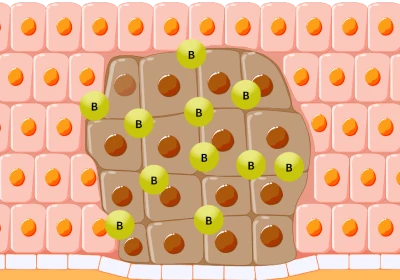
  • The ratio of BPA uptake in tumors and normal tissues is 2 to 4 times.

    禾榮科技

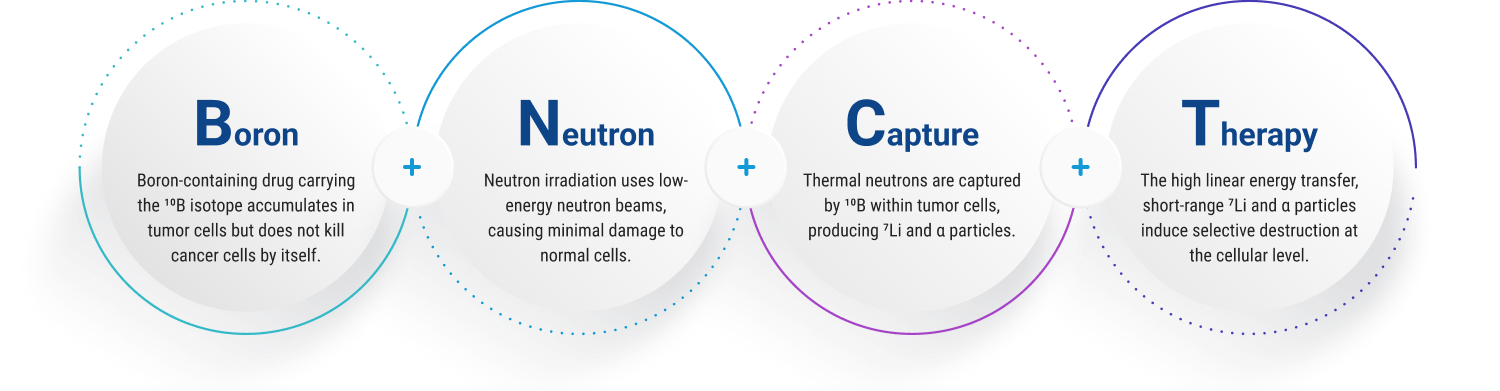
    Boron-containing drugs (e.g. BPA) are selectively accumulated in cancer cells.

  • Compared with photons, in terms of CBE, the lethality of BPA-absorbed neutrons to tumors is about 3 times higher than normal tissues.

    禾榮科技

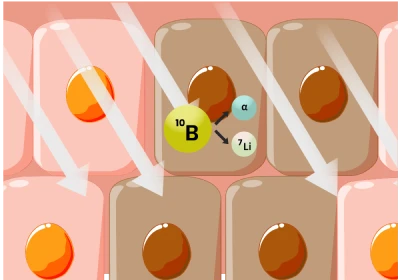
    After entering the body, super-thermal neutrons will decelerate into low-energy thermal neutrons and react with 10B to produce α and Li particles, which release energy and cause apoptosis of cancer cells by DNA double strand breaks at a distance smaller than the diameter of the cell. 

  • During radiation therapy, tumors receive about 9 times the boron dose than normal tissues.

    禾榮科技

    The ratio of boron dose in tumer cell and normal tissue is 9 times. If background dose is taken into account, the dose ratio between tumor and normal tissue is generally more than 5 times. Therefore, it has less impact on normal cells.

Features of BNCT

  • 禾榮科技

    Targeted

  • 禾榮科技

    Efficacy Predictable

  • 禾榮科技

    Safety

  • 禾榮科技

    Suit for diffuse tumors

  • 禾榮科技

    Short-Term Therapy

Evolution of BNCT

Now

1936s

  • The BNCT concept is proposed by G. L. Locher.
  • Proposed the application of boron-neutron capture reaction in tumor therapy.

1950s

  • Early reactor-based human clinical trials of BNCT are conducted in the United States.
  • Therapeutic efficacy is limited due to constraints in boron drugs and neutron sources.

1980s

  • Development of boron-containing drugs: BSH and BPA.
  • BPA gradually becomes the mainstream drug for clinical use.
  • Development of clinically applicable thermal and epithermal neutron beams.

2010s

  • Accelerator-based BNCT (ABNCT) technology matures, replacing nuclear reactors.
  • Japan spearheads accelerator-based BNCT clinical trials and commercialization.

2020s

  • Japan approves the world's first medical regulatory clearance for BNCT treatment.
  • BNCT enters the stage of commercialization and active clinical application.
  • Global acceleration of deployment spans multiple regions, including the US, Japan, Europe, and Asia.
go top top go top top